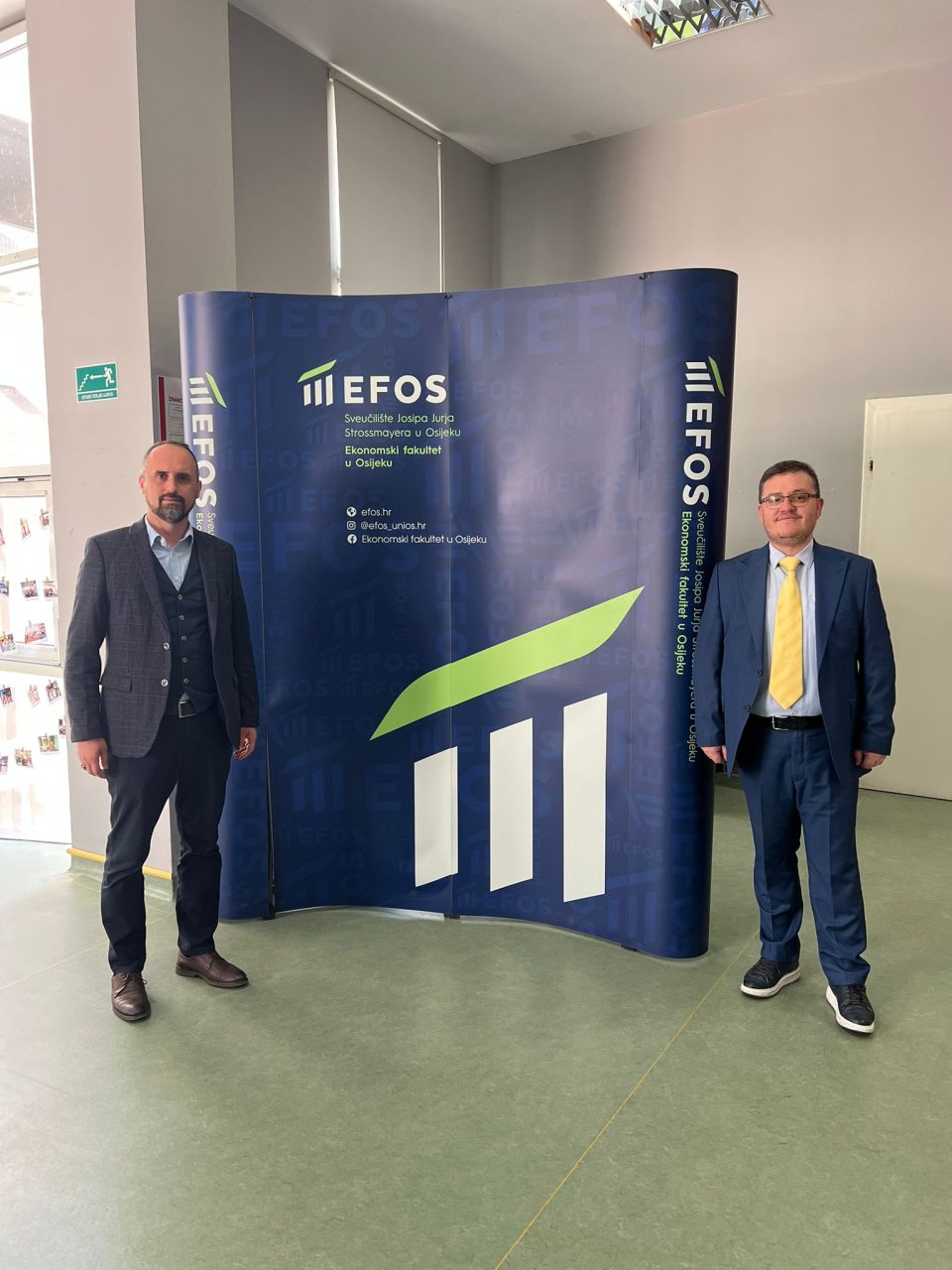
Within the framework of the international CEEPUS program, during the period 4–7 May 2026, professional activities were held at the Josip Juraj Strossmayer University in Osijek (Croatia) as part of the project “Supply Chain Management: From the Perspective of National Industries”. Representatives from universities from several Central and Southeastern European countries participated in this event, with the aim of strengthening inter-university cooperation, exchanging experiences, and advancing contemporary practices in the field of supply chain management and circular economy.
Within this prestigious network, the University of Tetova was represented by the Faculty of Economics, specifically by Dean Prof. Dr. Brikend Aziri and Asst. Prof. Dr. Ali Maksuti, Director of the Center for Circular Economy. Their participation focused on expanding institutional cooperation and promoting the faculty’s scientific capacities on the international stage.
The program of activities began with a coordination meeting among partner universities of the network, attended by institutions from Albania, Kosovo, Bosnia and Herzegovina, Croatia, Hungary, Moldova, Montenegro, Poland, and Romania. The meeting served to discuss contemporary challenges in supply chain management, economic digitalization, and the transition toward development models.
During the stay in Osijek, Prof. Dr. Brikend Aziri delivered a lecture titled “Supply Chains Performance: Achieving Strategic Fit and Scope” to local and international students, addressing the strategic dimensions of supply chain performance and the importance of aligning organizational objectives with the demands of the global market.
On the other hand, Asst. Prof. Dr. Ali Maksuti held several meetings with representatives of partner universities, focusing on advancing the Center for Circular Economy of the Faculty of Economics toward a joint international research platform. He also participated in the career fair organized by the host university, promoting the importance of connecting higher education with the labor market and the industrial sector.
In line with the project’s objectives, the university delegations also conducted study visits to important companies and businesses in Osijek, where participants had the opportunity to become familiar with modern practices in logistics management, production processes, and advanced economic models.